

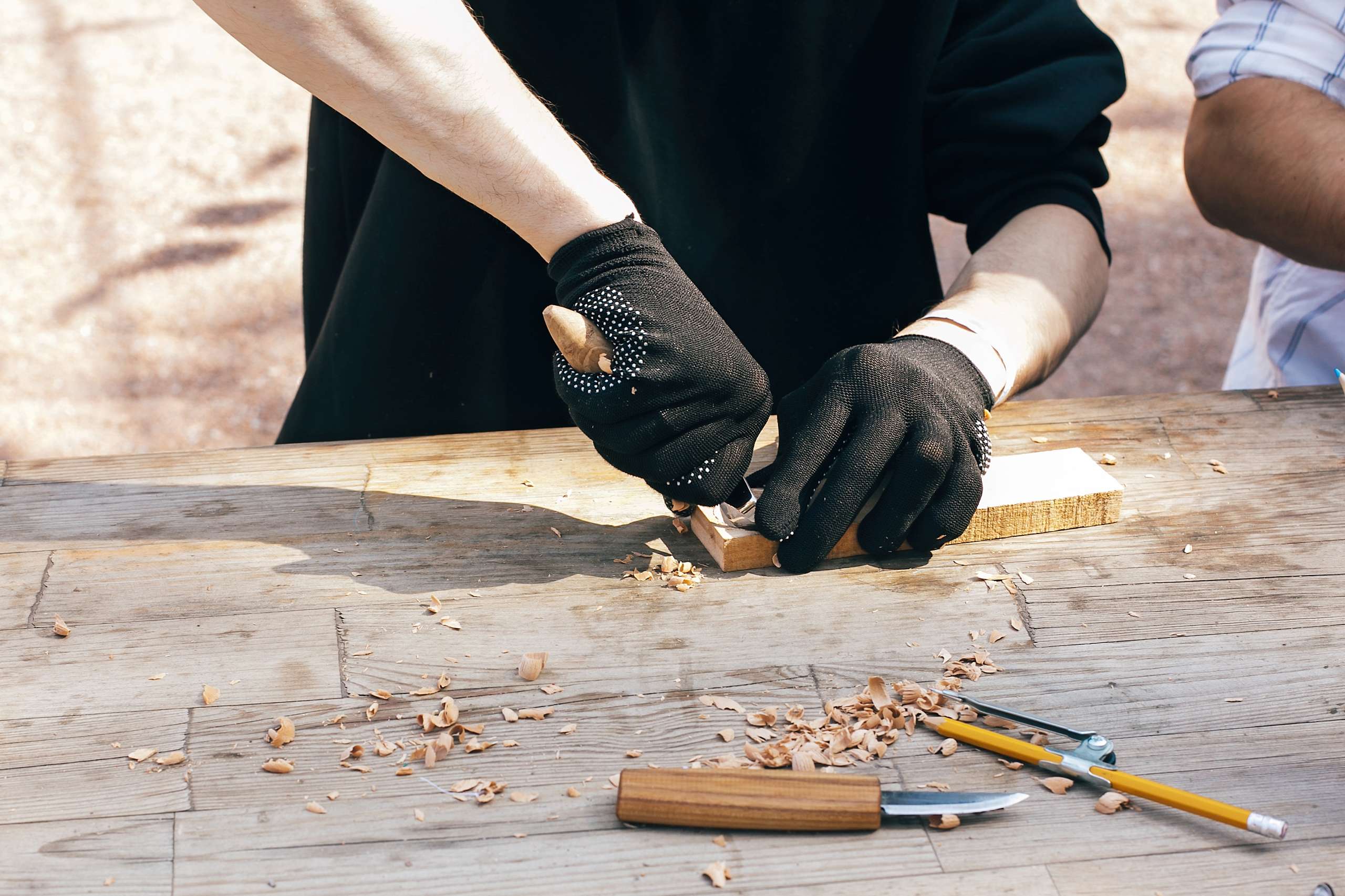
Accurate measuring is the first step to accurate woodworking, but it is often one of the first steps to get neglected. A mis-mark by as little as 1 millimeter can easily become a joint that doesn’t quite close, or a panel that doesn’t quite sit flat. Take the time to put your measuring device against the wood and look directly down on the mark to ensure that you are not getting any parallax error from looking at an angle. If you are making silly mistakes that are not easily explained, this may be the culprit. If you don’t know what parallax error is, don’t worry, it took me a while to figure it out too.
Marking your wood is just as important as measuring it. A thick line from a dull pencil makes it difficult to determine which side of the line you are cutting on, and if you have several pieces that need to be the same, you will likely have problems. Use a sharp pencil or marking knife to define a crisp line that you can cut or chisel to. Try holding the tip of the pencil in the wood and pulling it towards you in one smooth motion instead of sketching back and forth. You will get a nice, fine line that your saw or chisel can follow. If you are having trouble cutting to a line, it might not be your technique that is the problem.
Here is a quick exercise you can do to improve your measuring and marking skills. It should only take about 15 minutes. Take a scrap board and mark several different lengths on it. Then, go back and re-measure each of the lines before you cut them. Cut the board, and then test the results. If the ends don’t match up perfectly, go back and determine where the problem was. Was your mark off, or did you wander off of the mark while cutting? This process can provide a lot of useful feedback, but only if you take the time to reflect on it. If you don’t reflect, you will only end up frustrated.
Here’s another common mistake: measuring the same dimension on several different pieces that need to be identical. If your measurements are off by just a little bit each time, you will end up with several pieces that are all close, but don’t quite fit together. Instead, measure and mark one of them, and then use that piece as a pattern to mark the rest. You will be less likely to accumulate errors in this way.
I find that as my measuring skills have improved, I’ve slowed down quite a bit. I no longer rush through my work, and I don’t second guess myself near as much. I’ve come to expect that things will fit together properly, and when they don’t, I usually know why. I don’t need to spend a bunch of time sanding and planing parts to get them to fit right anymore, and I no longer consider accurate woodworking to be a mysterious magic trick that only some people can do.